Havanese Puppies available from Canadian Puppy & Dog Breeders in BC
|
|
|
|
These Havanese Puppy and Dog
Breeders can be found in
British Columbia, Canada
They will ship World Wide
|
|
Boys
|
Girls
|
Puppies
|
Photos
|
Links
|
|
|
Ultra-Sweet 100% Pure Havanese Puppies for the Discerning Dog Fancier.
Specializing in QUALITY Havanese - raised with love - shown with pride!
Well bred, well socialized puppies available to approved homes.
Havanese Dog Breed Information Including History
|
|
Havanese Dog Breed Profile
This adorable breed boasts the distinction of being the
Cuban national dog breed.
Although the Havanese is new to the AKC and CKC, the breed
has been in existence in it's native Cuba for centuries as
a treasured family pet, Bred to play with children in the
courtyards of aristrocratic cubans. Through the years, the
Havanese has been bred for companionship. It's gorgeous good
looks and endearing personality make the breed a wonderful
house pet. The Havanese is a VERY social animal, that
treats all with a friendly welcome.
|
Click to enlarge
|
|
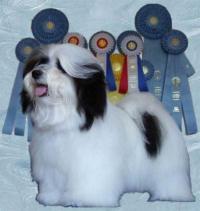
A hyper-allergenic Toy breed, the Havanese ranges in height
from 8 to 12 inches and weighs from 7 to 16 pounds. He has
large, dark and appealing eyes. The non-shedding coat is
long, soft, straight to wavy, and like human hair, is
odourless when wet. The breed comes in a rainbow of colors,
from white to shades of cream, champagne, gold, black, blue,
silver, chocolate or any combination of these. The plumed
tail is carried over the back.
Because the Gene pool of this rare breed is small, be sure
to view pedigrees to make sure the dog is bred well.
This breed is truly, the most TRENDIEST, friendliest and
popular companion breed of our era.
|
Havanese History
Courtesy of
Mimosa Havanese
The purebred Havanese is a member of the Bichon family which
includes the Bichon Frise, Coton de Tulear, Bolognese, Maltese,
Tvetnaya Bolonka, and perhaps the Lowchen. This group of small
long-haired dogs is very old and originated in the Mediterranean
in pre-Christian times. The first known representation is a
statue of a Maltese-type dog unearthed near Cairo Egypt. This
artifact is dated 600-300 B.C. Maltese-types are also featured
on Greek vases dated about 500 B.C. Ancient writers including
Aristotle and Timon made numerous flowery references in prose
and verse to the little white dogs from Malta.
|
|
For centuries these lap-sized charmers have been bred exclusively
as companion dogs to provide love, amusement and pleasure; a
role which they fulfill very well. These tiny breeds were
companions to the wealthy and socially powerful and as such,
their owners had the means to indulge their fancy in any way
they chose. Once the obligatory formal family portraits had
been painted, these affluent owners freely commissioned numerous
less formal paintings often including their precious pets.
Many antique portraits, most notably from the 15th, 16th and 17th
centuries, feature a companion dog that is similar in looks to one
or another of the Bichon breeds as they are now established. This
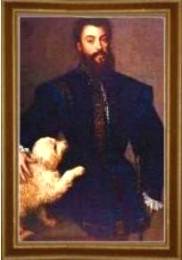
portrait of Frederico II Gonzaga - Duke of Mantua with his small
companion by his side was painted by the great artist Titian around
1523/1525. This painting currently hangs in the Prado in Madrid.
From the original antique "small dog", a number of varieties evolved.
As the centuries went by, interesting variations developed into
separate and distinct breeds around major port cities; each with a
slightly different temperament and appearance.
|
|
It is difficult to accurately pinpoint the origin of the Havanese breed.
Their history is drawn from conjecture and historical possibilities
rather than documented fact. The many theories of their evolution
and development are based on a composite of fact, fiction and legend;
however, all sources do agree that the Havanese was always a small
breed exclusively owned by the wealthy and socially powerful. The
Havanese breed is descended from the old-world bichon types of small
companion dogs such as antique versions of the Maltese and the Caniche
(ancestor of the Poodle). They are neither spaniels nor terriers. Both
Italy and Spain appear to have played a part in bringing the Havanese
to the new world.
Theory # 1 - One hypothesis is that Italians from Emelia
moved to Argentina with their little bichon-type dogs, where
they were bred with a small South-American poodle ( now extinct)
to create a new breed. Later, the dogs made their way to Cuba,
where they became known as the Havanese.
Theory # 2 - Others, including the esteemed writer,
Deschambre, were convinced that the Havanese were descended
directly from the Maltese, and that the Spaniards brought
the breed to the West Indies where they were known as the
Havana Silk Dog.
Theory # 3 Another theory is that the breed arrived
in Cuba during the days of the expanding Spanish Empire.
Theory # 4 - The theory held in most popular belief is
that of the Cubans themselves. Cubans maintain that the first
Havanese were brought to their shores by commercial ship's
captains who raised them on board their ships or perhaps
exchanged them with other traders. In those times, sea merchants
were a rough and tumble lot. Approved cargo was often traded for
more lucrative illicit cargo along the way. In all likelihood,
there were as many pirates and private traders as there were
commercial traders supplying the island. Any sea merchants arriving
on Cuba to engage in trade knew their financial success depended
largely on the support and business of wealthy Cubans. Presenting
affluent wives with the gift of a small rare dog was a clever ploy
that turned out to be instrumental in gaining the traders entry
into the influential Hispanic homes that might otherwise have
turned them away. The captains of different vessels traded dogs
with each other so that they could return to each port with a
dazzling variety of coat colours to enchant and delight the
families. According to this theory, it is this extensive trading
and colour mixing that resulted in the very impressive coat variety
of today's Havanese which can be found in every colour and nearly
every variant of marking seen in dogs.
Theory # 5 - Cuban author, Zoila Portuendo Guerra, who
was the founder of the Habanero Club in Cuba brings forth perhaps
the most logical theory in her book titled "Bichon Havanese". Her
extensive research has attempted to sort through the lore, fact
and fiction and presents a very plausible progression that
incorporates facets of the many other theories long held in popular
belief. She is adamant that there have been two Cuban breeds.
According to her, the first of these, was the now extinct "Blankito
de la Havana" developed on the island in the16th and 17th centuries
during the days of Spanish colonization. This breed would have been
a refinement of small bichons and lap dogs brought over directly
from Spain or smuggled in illicitly by pirates and sea merchants.
During these times, in Europe, the height of fashion were tiny
immaculate white dogs as companions to the ladies of high society.
The Cubans emulated this fashion in the development of the Blankito.
He would have been a very small dog, weighing just 3-6 pounds, pure
white, with a very silky, perhaps curly long coat. This original Cuban
dog, the Blankito would have been the breed that returned to the
continent in the early 18th century to be recognised with much fanfare.
Much of the confusion surrounding the breed may come from the fact that
in Cuba it was erroneously referred to as the "Maltese" while in Britain
it was acclaimed as the "White Cuban". It was known throughout the rest
of Europe as the "Havanese " because it came from Havana or later as the
"Havana Silk Dog" because of their profuse soft coats. Mrs Guerra
maintains that the Blankito would have remained a tiny white charmer
till the early 19th century.
In the early 1800's many immigrants from Continental Europe settled on
the island bringing with them their own little lap dogs, most notably
small coloured poodles from France, Belgium and Germany. These new dogs
were bred with the Blankito and a new breed subsequently evolved, a
little bit larger and with a coat of many colours. The author
portends that this second native of Cuba, created on the island
during the 19th century is the Havanese breed as we know it today.
Is this finally the actual account of our breed's history and
development? ...... perhaps .... but who can say for sure?
We are likely to never actually know the truth and the true origins
will always remain lost in a blend of fact, fiction and folklore.
Regardless, by all accounts, the Havanese as had the Blankito before
it, became popular as the pampered pet of wealthy residents of the
island of Cuba and was most popular in the capital city of Havana.
The exclusivity of Havanese ownership was jealously maintained by
the upper social classes. These tiny companions were as cherished
and treasured as precious jewels. Havanese were a frequent sight in
villas, manors and on country estates but; just as the well-to-do
women who owned them, these little dogs were rarely seen in the
streets or public places. They lived out their lives in pampered
luxury in the rooms or interior courtyards of their tropical homes.
It was said that on special occasions or on Sunday afternoons, these
women, decked out in their most elegant finery , would ride through
the streets of the capital in their carriages with their precious
Havanese at their side. These dogs were also known as "Perritos de
la Falda" (Skirt dogs) because they were small enough to hide
beneath a lady's skirts. During their days of favour in Cuba,
Havanese were bred but never sold. Litters were carefully planned
and precious puppies were subsequently gifted as special tokens of
esteem to favoured friends or in thanks to someone who had provided
a valuable service to the family. One of the best-known Cuban breeders
was Senora Catalina Laza, the wife of a wealthy sugar baron. Many of
her friends were the lucky recipients of her generosity.
As happened to many other dog breeds according to the fickleness
of fashion, the popularity of the Havanese dimmed as the years went
by... Havanese numbers dwindled until they eventually became almost
extinct -- even in their native Cuba.
Revolutions are seldom kind to dogs. The Cuban revolution of 1959
nearly destroyed the breed. Thousands of people fled the island
turmoil in great haste, with few of their possessions in hand.
Since many fleeing people expected to return in a few weeks or
months, their beloved little pets may have been left behind,
entrusted to the care of a friend, or faithful servant. Since
Havanese were associated with the ruling class, those that remained
on the island may not have faired very well. As had occurred
following the French and Russian revolutions, the cherished breed of
the over-thrown classes may have been actively or passively eliminated.
Only three families are known for sure to have taken their Havanese
with them when they fled Cuba, including the Fantasio and Perez families.
These and perhaps a few other dedicated exiles in Costa Rica and the
USA persevered for over a decade to preserve this breed. For years it
seemed doubtful if any Havanese remained in Cuba.
Saving Grace:
In the early 1970's Bert and Dorothy Goodale of Colorado began looking
for a small breed to raise which would have a calm temperament and
intelligence; attributes that they most cherished in dogs. They had
considerable experience raising Irish Wolfhounds and Soft Coated
Wheaten Terriers. After a few years of investigation, elusive
references to the Havanese had caught their attention, but no one
knew how/where to obtain them. The Goodales chanced across an advertisement
that resulted in the purchase of 6 pedigreed Havanese. These included one
dam along with four female progeny and a young unrelated male. The Goodales
became completely enchanted with the delightful nature of the breed and
strove to gather more of the little Cuban exiles. Some months later,
through advertisements placed in Spanish language papers came another
breakthrough. Ezekiel Barba, an elderly Cuban who had fled during the
revolution and subsequently settled in Costa Rica was moving to Texas
to live with a daughter. Because of failing health, he could no longer
care for his Havanese entourage. He entrusted the Goodales with 5 of his
Havanese. This gave the Goodales two new bloodlines to work with. Both
the first and second groups of dogs displayed the same look; sweet,
gentle temperament and were of similar size (as adults , averaging
10-12 lbs and 9-10 inches tall). Based on the written pedigree information
that came with the dogs , a 1963 breed standard and her years of breeding
knowledge, Dorothy carefully began a breeding program to prevent the possible
extinction of this delightful toy breed. We, who have come to know and love
the Havanese, will be ever grateful for her dedicated efforts.
|
|
Not till 1991 was anyone sure that the Havanese still existed in Cuba.
The Bichon Habanero Club was established to study the island's remaining
indigenous dogs to ascertain their purebred status. After careful study
and consideration, a closely supervised breeding program was put into
place using a foundation stock of approximately 15 dogs. In 1997 the
first Havanese was exported from Cuba to the Netherlands. As in days gone
by, the Havanese is again making its mark as the Bichon of Cuba, though
no longer as a token of high society. In Cuba today, Havanese can be found
in great numbers in the Capital of Havana as well as in the towns throughout
the countryside. Whether he is peeking through balcony railings, gracing a
country porch, or walking at his owners side; he is a charming pet for
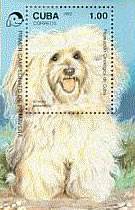
all. In a loving tribute to its native breed, Cuba chose the image of a
Havanese to grace a 1992 souvenir issue postage stamp.
The Havanese, though still quite rare is gaining popularity in North
America and throughout Europe.
|
|
|
Click to Enlarge
|
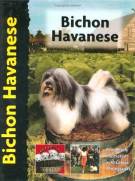
A Great Book on the Havanese
There are a few Havanese books on the Market, but this one written
and published by our friend Zoila, in CUBA, is by far our personal
favortite.
This book is available from Alida at:
Salidadelsolhavs@shaw.ca and from Emily & Bev at:
mistytrails@uniserve.com, amd from
Amazon.com
Bichon Havanese (Pet Love)
by Ziola Portuondo Guerra (Hardcover - September 16, 1999)
This version, of Zoila's book, called Bichon Havanese, is
recomended over the New Version of her book, published in
South Korea, "KennelClubBook: Havanese"
|
|
|
This website built and maintained by
MSR Web Design at Meadow Springs Ranch
|
|